

The Butterfly Effect: Science learning across Advent
All around The Advent School, students are thinking, talking, observing, and wondering about the Monarch butterfly.
In ECC, kids used magnifying glasses to take a closer look at caterpillars as they munched on milkweed and climbed among the leaves. They captured their observations through drawings, slowing down to notice the small details of the natural world.
In Kindergarten, students discovered that one of their caterpillars had formed a J-shape—a sign that it was preparing to make its chrysalis. Just minutes later, they had a front-row seat to the transformation as the caterpillar performed its “pupa dance,” spinning silk and preparing to enter its next stage of life. The excitement in the room was palpable as students watched the transformation unfold before their eyes.
In Third Grade, students witnessed another remarkable moment: a monarch butterfly emerging from its chrysalis. Their excitement quickly turned into questions, ideas, and creative exploration, inspiring students to use loose parts and LEGO to make their thinking visible.
Meanwhile, Sixth Grade students are studying the monarchs as they begin their science journals, focusing on the first two steps of the scientific method: observation and questioning.
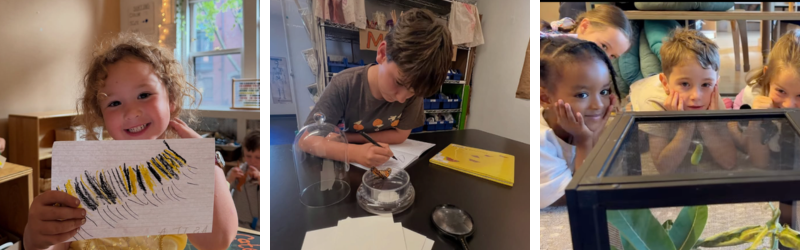
Across grade levels, building time into the day to pause, look closely, and sketch what they see gives students the space to develop their natural curiosity and turn observations into meaningful questions:
How much do caterpillars eat?
How do they come out of such a tiny egg?
How can you tell if they are male or female?
Why are the chrysalises different colors?
Why is that caterpillar hanging out at the top?
What is the “glue” the caterpillars make that allows them to stick to the top?
What is their habitat?
These questions are more than expressions of curiosity—they are the beginnings of scientific inquiry. By observing closely and wondering deeply, students begin to identify the questions that will guide their next steps and lead to deeper investigation.
And eventually, all of this wondering culminates in one of Advent’s most beloved traditions: the Monarch Butterfly Parade on Friday, October 2.
Students and faculty from across the school will parade to the Public Garden, celebrating the monarchs and the learning that has unfolded throughout the school. When nature permits, faculty will release monarch butterflies to begin their migration to Mexico. Students create masks and banners and sing a special song to send the butterflies off on their journey.
We hope all Advent families will join us for this special tradition! Parents and caregivers who would like to march in the parade can meet the students on the front steps of the school at 8:50 a.m.
