

Literacy Moments across Advent
Across The Advent School, literacy learning takes many forms—from building letters and strengthening handwriting skills to playing with language, experimenting with different genres, and finding creative ways to tell a story. Here’s a look at some of the literacy moments happening in classrooms this week.
ECC
This week, ECC students were introduced to the wooden pieces they will use to form capital letters. They learned four different types of pieces: big line, little line, big curve, and little curve. Using capital-letter cards as guides, students practiced identifying the pieces and the order needed to form each letter. After our whole-group introduction, students worked independently at a table, using the materials to build capital letters of their own.
Kindergarten
Kindergarteners are working on handwriting through Frog Jump Capital Letters—letters that begin with a vertical line before students lift their pencils and “jump” back to the top to complete the letter. Students reviewed each letter’s sound and then built the letters with Mat Man blocks, identifying big curves, little curves, big lines, and little lines. They practiced writing each letter in the air, tracing it on the light table or rug, and finally writing it on their chalkboards.
First Grade
First Graders are learning about verbs and having fun putting them into action! Students chose a verb and acted it out while their classmates tried to guess the word. Through this playful activity, students practiced identifying verbs and thinking about the many ways action words can be used. It was a lively way to connect grammar, vocabulary, movement, and speaking skills.
Second Grade
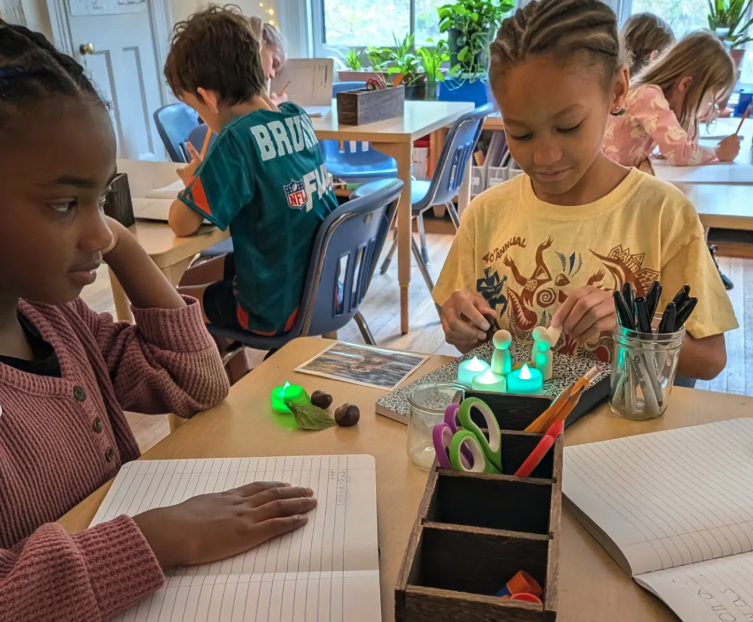
Second Graders reviewed the CUPS editing checklist, a proofreading strategy that stands for Capitalization, Usage/Understanding, Punctuation, and Spelling. After reviewing each part of the checklist, students headed off to build, draw, and play games. The purpose? They will use these shared experiences as the inspiration for their writing, describing what they built or played with and then using CUPS to carefully edit their work.
Third Grade
Third Graders practiced shared-experience writing through a classroom treasure hunt! Students worked together to follow clues and collect information along the way before returning to the classroom to crack a code. Once they had completed the challenge, students used the experience as inspiration for their writing, turning the events of the treasure hunt into a complete story. The activity gave students a shared experience to draw on as they practiced sequencing and storytelling.
Fourth Grade
Fourth Graders’ curiosity about news and newspapers led them to explore this style of writing. Each student is creating an “All About Me” newspaper featuring three or four original headlines connected to their own lives and experiences. Students are using familiar paragraph outlines to brainstorm and develop a paragraph for each headline. The project is helping students get to know one another while also providing a fun, authentic way to jump back into the routines of writing.
Fifth Grade
Fifth Graders are writing curator statements—200- to 400-word pieces that explain the central idea or meaning behind an image or art exhibition. Students began by choosing an image that spoke to them, whether it featured a place, a sport, a celebrity, or something else meaningful to them. They are now writing about their selections, exploring what the image makes them feel and why they chose it. The project combines personal reflection with clear, purposeful writing.
Sixth Grade
Sixth Graders are exploring poetry, beginning with a scavenger hunt for literary devices such as similes and metaphors. After reading the original I Am From poem, students began brainstorming ideas for their own versions. They considered the people, places, experiences, traditions, and details that have shaped their lives before moving into their first of several drafts. Through the writing and revision process, students are discovering how poetry can capture personal stories in powerful ways.
From the earliest stages of forming letters to the more sophisticated work of crafting personal poetry, Advent students are developing their voices as writers and communicators. Across every grade, literacy is not just about learning the mechanics of language—it’s about using words to explore ideas, share experiences, ask questions, and make meaning.
