

The Light We Share
My office, with its view west over the Charles River, is a great spot from which to get a sense of the sun’s decline toward the southern horizon as days grow shorter and colder, and so to look forward to the growing daylight of the coming months.
This time of year, when the descent to darkness stops and daylight begins to bounce back at the solstice, is celebrated in many traditions. The Zuni and Hopi of the southwest observe Shalako and Soyal, the Persians traditionally celebrated the birth of the sun-god Mithra in the festival of Yalda, and the Roman emperors honored the cult of Sol Invictus, the unconquered Sun. The Chinese celebration of Dong Zhi marks the return of longer days and positive energy. More familiar to many of us are the Hanukkah lamp that burned for eight days in the temple, and the arrival of light in the darkness in the shape of an infant celebrated by Christians.
A former colleague used to argue that, in schools, the solstice was a well-timed symbol of the revival that the winter break affords just when teachers’ and students’ energies are ebbing with the onset of winter.
But there is a subtler sense to the season that the various traditions point toward.
This time of year invites reflection on the resilience of life’s light and energy. In an ancient Indian Upanishad, a legendary king, Janaka, asks the sage Yajnavalkya, “What is the light for a human?” Yajnavallkya gives a series of answers–first the sun, then, when the sun has set, the moon, and, when the moon is dark, fire. Ultimately, however, the light for humans is the Self, the awareness that shines in the heart of all, that lights our lives. Without that, there would be no one to see the world that the sun, moon, and fire illuminate. This light is human consciousness, our sense of an “I” looking out at a world, which neuroscientists are trying to map, but that many philosophers say is beyond explanation.
But that mysterious awareness, directed as attention, is indispensable to our lives together. It is that which binds family and community around a shared meal or gathering. A parent’s love for a child is most evident in the attention they share, and it is the heart of the bond of friendship, as happens when two friends are absorbed in conversation as the world around them seems to vanish.
Closer to Advent, a teacher’s attention not only creates the connection with a student that makes learning possible, but gives the child the assurance they need to open their attention to wonder, exploration, and growth. It is this light, the awareness we share, which, directed as attention, is the most precious, essential ingredient of our work as a school.
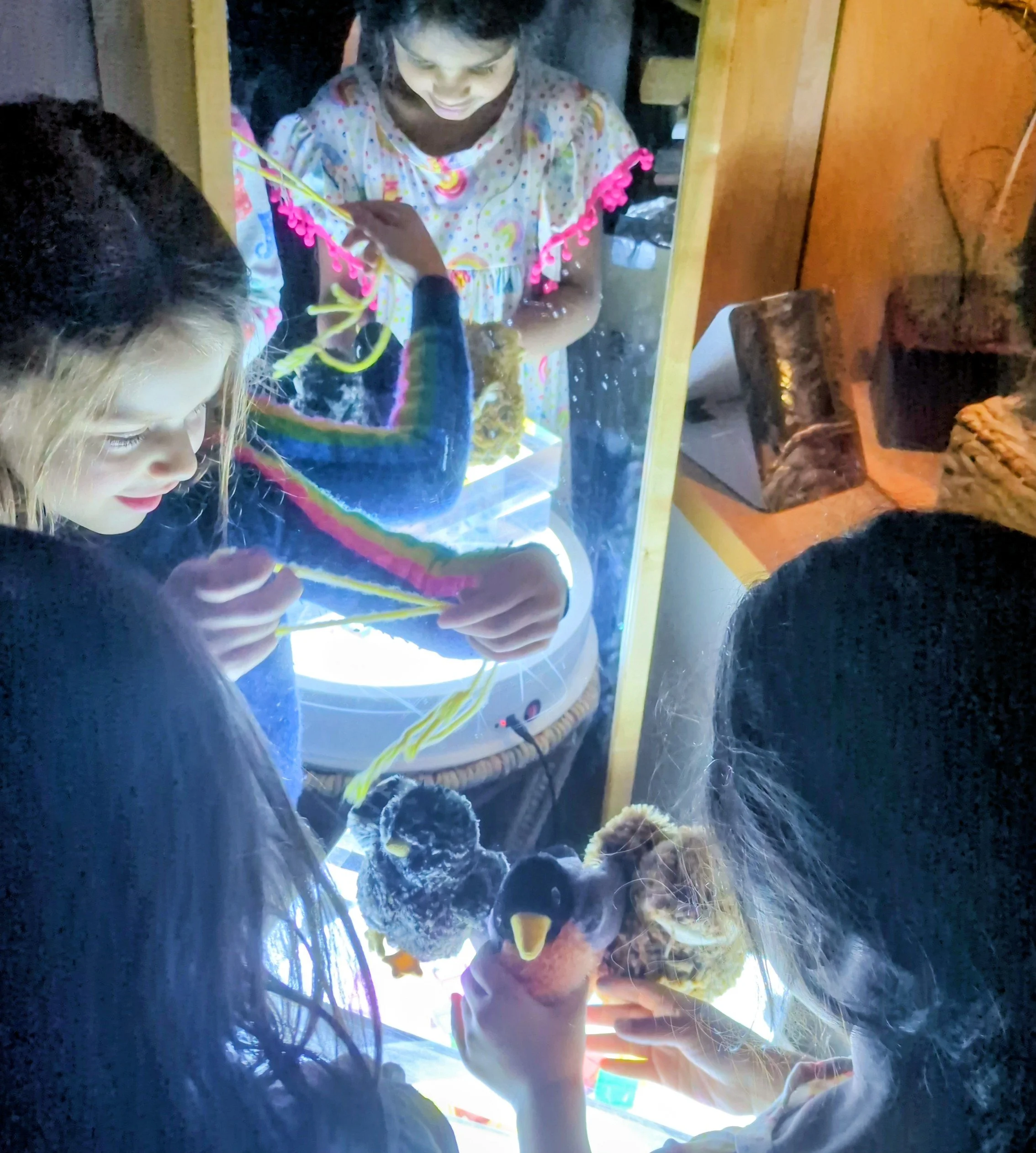
The Atelier’s light table is a source of curiosity, creativity, and joy for students.
In the coming days as the sun outside my window begins to rise back up over the Hatch Shell on the Esplanade, I wish you all light and life, and hope that you can, this vacation, share your attention, your light, with those nearest and dearest to you.
Warmly,